You have made it through the rounds. The hiring manager likes you, HR has called back, and an offer is coming. This is the moment that most Delhi professionals handle worst – not because they lack confidence, but because they walk into the salary conversation without data. They guess. They hope. They accept whatever is put in front of them.
But in 2026, there is no reason to negotiate blind. LinkedIn’s salary tools give every professional – free and Premium alike – access to real Delhi salary data that was previously only available to HR departments and recruiters. Understanding how to use LinkedIn salary insights before you receive or respond to an offer is one of the highest-impact career moves a Delhi professional can make.
This guide is the complete playbook for salary negotiation LinkedIn Delhi professionals can actually use. You will learn how to find and read LinkedIn’s salary data for your specific role and location, how to cross-reference it with other Delhi salary sources, how to build a number you can confidently defend, and exactly what to say when the moment comes. Whether you are a fresher negotiating your first CTC in Gurugram or a senior manager evaluating a Director-level offer in Connaught Place – this guide is built for you.
Let us start with the tool itself.
What Is the LinkedIn Salary Tool and How Does It Work for Delhi Professionals?
The LinkedIn salary tool is a built-in feature on LinkedIn that shows salary ranges for specific job titles, locations, and experience levels – based on data self-reported by LinkedIn members and enriched with third-party compensation data. It is available on LinkedIn’s desktop and mobile platforms, and while some features require LinkedIn Premium, the basic salary data is accessible on free accounts.
Here is how to access it:
- Go to LinkedIn and click on the ‘Jobs’ tab in the top navigation
- Search for your target role – for example, ‘Product Manager’ or ‘Software Engineer’
- On any job listing, scroll down to find the salary estimate LinkedIn shows for that specific role
- For a broader search, go to linkedin.com/salary and search by job title and location (Delhi, Gurugram, Noida, New Delhi)
- The results show a salary range – base pay distribution – along with breakdowns by experience level, education, and company size
The LinkedIn salary tool is not a single number – it is a distribution. It shows the 10th percentile, median, and 90th percentile of reported salaries for your role and location. For salary negotiation LinkedIn Delhi purposes, this distribution is far more useful than a single average figure because it tells you the full range of what people in your role are actually earning in Delhi’s job market.
| LinkedIn Salary Tool Feature | Free Account | LinkedIn Premium | Why It Matters for Delhi Negotiations |
| Basic salary range for role + city | Available | Available | Baseline market data for your specific role in Delhi |
| Salary by experience level | Available | Available | Compare your years of experience to salary brackets |
| Salary by company size | Limited | Full access | Delhi MNCs vs startups vs mid-size pay very differently |
| Salary by education level | Limited | Full access | Understand how your degree affects market positioning |
| Salary trends over time | Not available | Available | See if Delhi salaries for your role are rising or flat |
| Comparable roles salary | Limited | Full access | Know what similar roles in Delhi pay – useful for alternatives |
| Skills that increase pay | Limited | Full access | Which specific skills in Delhi command a salary premium |
Did You Know? LinkedIn’s salary data for India is sourced from over 8 million self-reported salary data points from Indian professionals – making it one of the largest voluntary compensation datasets available for the Indian market. For Delhi specifically, roles in IT, consulting, and BFSI have particularly strong data coverage, which means LinkedIn salary insights for these sectors in Delhi are among the most reliable free compensation benchmarks available in 2026.
Also Read – How to Use LinkedIn’s ‘Open to Work’ Feature Without Alerting Your Boss in Delhi
How to Check Salary on LinkedIn for Delhi Jobs – Step by Step
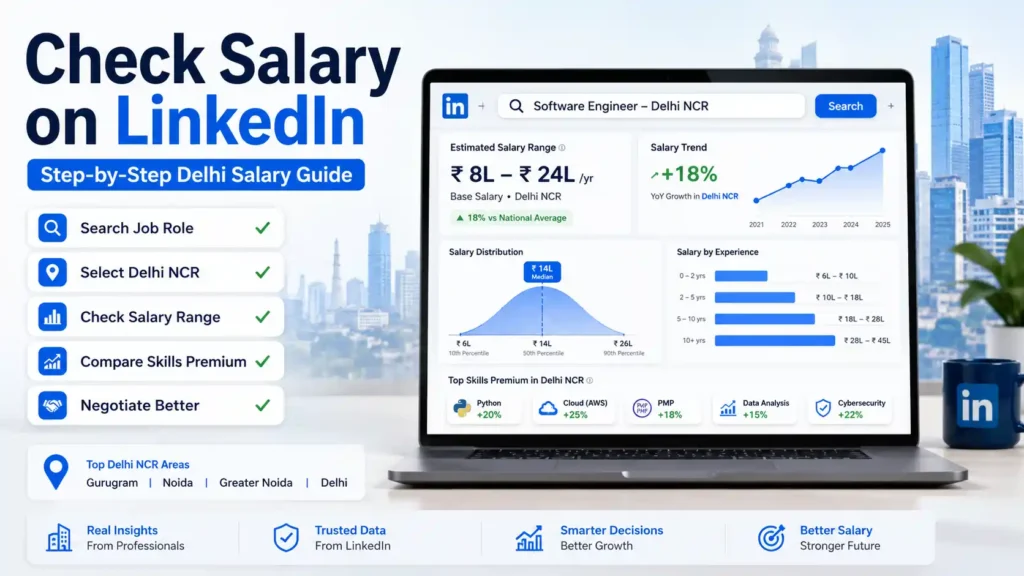
Knowing how to check salary on LinkedIn for Delhi jobs is the practical starting point for any salary negotiation LinkedIn Delhi strategy. Here is the exact process:
Step 1: Go to LinkedIn Salary Search
Visit linkedin.com/salary on desktop. On mobile, go to the Jobs tab and search for roles with salary filters. Type your exact job title – be specific. ‘Software Engineer’ and ‘Senior Software Engineer’ have very different salary ranges in Delhi. ‘Marketing Manager’ and ‘Digital Marketing Manager’ also differ significantly.
Step 2: Set Your Location to Delhi NCR
For Delhi professionals, the location selection matters significantly. Here is what the data typically shows for different Delhi NCR sub-locations and how to use them:
- New Delhi – Use for central Delhi roles including government-adjacent consulting, media, and traditional corporate sectors
- Gurugram (Gurgaon) – Use for MNCs, tech companies, BFSI, and consulting roles. Gurugram typically shows 10 to 20 percent higher salary ranges than central Delhi for equivalent roles
- Noida / Greater Noida – Use for IT services, BPO, and mid-size tech companies. Typically shows slightly lower ranges than Gurugram for senior roles
- Delhi NCR (combined) – Use when your offer is from a company with multiple NCR locations, or when you want the broadest market view for Delhi salary data
Step 3: Filter by Your Experience Level
LinkedIn’s LinkedIn salary insights break down compensation by experience bracket. Match your filter to your actual years of experience – not the experience level on the job description. If you have 6 years of experience but are applying for a role listed as mid-level, check both the ‘mid-level’ and ‘senior’ filters to understand the full range you should be targeting.
Step 4: Read the Full Salary Distribution – Not Just the Median
The most important negotiation tips around LinkedIn salary data: never anchor your negotiation to the median. The median is the middle of the market – it is where average candidates land. Your negotiation target should be the 65th to 75th percentile of the distribution, especially if you have above-average skills, relevant certifications, or a specific track record of achievements. For salary negotiation LinkedIn Delhi, knowing the full range tells you both where to set your target and what the ceiling looks like.
Step 5: Note the Skills Premium Data
LinkedIn’s salary page shows which skills correlate with higher compensation for your role in Delhi. This is powerful LinkedIn salary data for Delhi professionals 2026 that most people miss entirely. If the data shows that Python, cloud certifications, or PMP credentials add 15 to 25 percent to salary ranges for your role – and you have those skills – they become explicit justification in your negotiation conversation.
Is LinkedIn Salary Data Accurate for India – What Delhi Professionals Need to Know
This is one of the most important questions to answer honestly before building a salary negotiation LinkedIn Delhi strategy around LinkedIn data. The answer is nuanced – and understanding its limitations makes the data more useful, not less.
Where LinkedIn Salary Data Is Reliable for Delhi
- Large sample roles – Software Engineer, Product Manager, Data Analyst, Business Analyst, HR Manager, Finance Manager. These roles have thousands of Delhi data points and the ranges are reliable
- IT and technology sector – Delhi NCR’s tech ecosystem is one of LinkedIn’s most data-rich segments in India. Salary ranges for tech roles in Gurugram and Noida are among the most accurate in the country
- MNC and large Indian corporate roles – Professionals at large employers are more likely to have reported their salaries on LinkedIn, making these segments more reliable
- Experience level comparisons – The relative differences between junior, mid, and senior salary bands in Delhi are consistently reflected in LinkedIn’s data, even if absolute numbers vary
Where LinkedIn Salary Data Has Limitations for Delhi
- Very niche or specialised roles – If your role is highly specific – niche legal tech, quantum computing, very specialised finance roles – sample sizes may be too small for reliable Delhi data
- Early-stage startups – Delhi’s startup ecosystem, particularly in Noida and South Delhi, includes many companies where equity and variable pay make CTC comparisons misleading. LinkedIn data primarily captures fixed pay
- Government-adjacent and public sector roles – LinkedIn data has poor coverage for government, semi-government, and public sector organisations in Delhi
- Very senior roles (VP and above) – C-suite and VP-level compensation Delhi data on LinkedIn is sparse because senior professionals rarely self-report detailed compensation data
How to Use LinkedIn Data Accurately Despite Its Limitations
The most effective salary negotiation LinkedIn Delhi approach is to use LinkedIn salary data as one of three data points – not your only source. Cross-reference it with:
- Glassdoor India – Glassdoor has strong anonymous salary reporting for Delhi’s corporate sector, particularly for MNCs and large IT firms
- AmbitionBox – India’s most widely used salary comparison platform. Particularly strong for Delhi IT, consulting, and BFSI roles
- Peer conversations – Trusted colleagues or batch-mates at target companies are the most accurate Delhi salary data source available – use your network
Did You Know? A study of salary negotiation outcomes in India found that professionals who enter negotiations with three independent salary data points are 60% more likely to successfully negotiate above the initial offer compared to those who negotiate without data at all. For Delhi professionals, combining LinkedIn salary insights with AmbitionBox and Glassdoor data creates exactly this kind of multi-source validation that makes your number difficult to challenge.
Also Read – How to Set Up LinkedIn Job Alerts for Delhi NCR [Step-by-Step Guide 2026]
How to Research Salary on LinkedIn Before Accepting a Delhi Offer – Complete Process
Knowing how to research salary on LinkedIn before accepting Delhi offer is the foundational step in any salary negotiation LinkedIn Delhi strategy. Here is the complete research process Delhi professionals should follow before responding to any offer:
Research Phase 1: Your Role at the Specific Company
- Search LinkedIn salary for your exact role title + Delhi/Gurugram/Noida – note the 25th, 50th, and 75th percentile numbers
- Look up the specific company on LinkedIn – note their company size and industry, then filter LinkedIn salary data to match
- Search for current employees at the company with similar titles – their profiles sometimes reveal compensation signals through certifications, benefits, or LinkedIn Premium badges that indicate seniority level
- Check if the company posts salary ranges in their job descriptions – some Delhi companies have started including salary bands in postings. If they posted this role before, find that posting
Research Phase 2: Market Comparables
- Identify 3 to 5 comparable companies in Delhi that hire for your role – check LinkedIn salary data for each and note the ranges
- Find 2 to 3 people in your LinkedIn network at similar roles – if you have trusted connections at peer companies in Delhi, a direct conversation about market rates gives you the most accurate benchmark
- Check AmbitionBox and Glassdoor for the specific company – reviews often mention salary ranges in the context of employee experience
Research Phase 3: Build Your Target Number
After completing both research phases, you should have a realistic Delhi salary data range from multiple sources. Here is how to convert that research into your negotiation number:
- Set your walk-away number – the minimum you will accept based on your financial needs and the market data
- Set your target number – the 65th to 75th percentile of your researched range, adjusted upward for any premium skills you bring
- Set your opening ask – 10 to 15 percent above your target number. This gives room to negotiate down while still landing at or above your target
| Salary Research Step | Time Required | Source | How to Use in Negotiation |
| LinkedIn salary search (role + Delhi) | 10 minutes | LinkedIn Salary Tool | Baseline market range – cite as ‘market data’ |
| AmbitionBox company-specific search | 10 minutes | AmbitionBox.com | Company-specific benchmark – more targeted |
| Glassdoor India search | 10 minutes | Glassdoor.in | Cross-validation and review of total comp structure |
| Peer network conversation | 30 to 60 minutes | Trusted connections at peer companies | Strongest single data point – cite as ‘conversations with peers’ |
| LinkedIn skills premium data | 5 minutes | LinkedIn Salary skills section | Justify premium if you hold high-demand skills |
| Total research time | 75 to 105 minutes | Multiple sources | Enter negotiation with fully defensible number |
Also Read – Top 15 LinkedIn Keywords to Rank Higher in Delhi Job Searches (2026 Guide)
Salary Negotiation Tips Using LinkedIn for Delhi Job Offers – What to Say and When
Having salary negotiation tips using LinkedIn for Delhi job offers backed by real data is only half the equation. The other half is knowing exactly what to say – and when. Here is the complete conversation guide for Delhi professionals:
When to Bring Up Salary
The most common mistake Delhi professionals make in salary negotiation LinkedIn Delhi conversations is raising salary too early – during the first or second interview round. The ideal timing is:
- After you receive a verbal or written offer – never before. Negotiating too early signals that you are more interested in the money than the role
- Within 24 to 48 hours of receiving the offer – this shows you have done your homework. Responding immediately with a counter looks reactive. Taking more than 3 days looks disinterested
- Before signing any offer letter – once you sign, negotiation is effectively over. Use the window between verbal offer and written offer letter as your primary negotiation window
What to Say When the Number Is Too Low
Here is the exact language structure that works for salary negotiation LinkedIn Delhi conversations:
Opening (acknowledge, then pivot):
“Thank you for the offer – I am genuinely excited about this role and the team. Based on my research of market compensation for this position in Delhi, including LinkedIn salary data and conversations with professionals in similar roles, the range I am seeing for someone with my experience and skill set is [your researched range]. Given my background in [specific achievement or skill], I was hoping we could discuss [your target number]. Is there flexibility there?”
This structure works because it: acknowledges the offer positively, cites specific LinkedIn salary data for Delhi professionals 2026 as evidence (not personal desire), references your specific value, and asks a question rather than making a demand.
What to Say When They Push Back
When the employer says ‘that is beyond our band’ or ‘this is our standard offer for this level’ – do not accept immediately. Use this response:
“I understand there may be budget constraints at this level. I want to make this work – could we explore other components of the compensation Delhi package? For example, a signing bonus, an early performance review at 6 months rather than 12, additional leave, or a higher variable pay component could help bridge the gap.”
This response shows flexibility, professionalism, and knowledge of how total compensation Delhi packages work – all of which are positive signals to Delhi hiring managers.
What to Say When They Ask for Your Current Salary
This is a common Delhi hiring practice – and one that puts candidates at a disadvantage if handled incorrectly. The professional response that redirects to market data:
“My current compensation is structured in a way that makes direct comparisons difficult given the different components involved. What I am focused on is the market rate for this role in Delhi, which based on my research is [your researched range from LinkedIn salary insights and other sources]. That is the benchmark I am using for this conversation.”
This response is honest, professional, and redirects the conversation from your current salary – which anchors the discussion to where you are – to market data, which anchors it to where you should be.
Did You Know? Research on salary negotiation in India consistently shows that candidates who negotiate receive an average of 10 to 20 percent higher compensation than those who accept the first offer. In Delhi’s job market specifically, where salary budgets are often set with negotiation room built in, accepting the first offer means leaving real money on the table. The LinkedIn salary tool gives Delhi professionals the data they need to negotiate with confidence rather than anxiety.
Also Read – LinkedIn Job Search Hacks: How to Find Hidden Jobs in Delhi NCR (2026 Guide)
LinkedIn Salary Comparison Tool for Indian Professionals – How to Use It Most Effectively
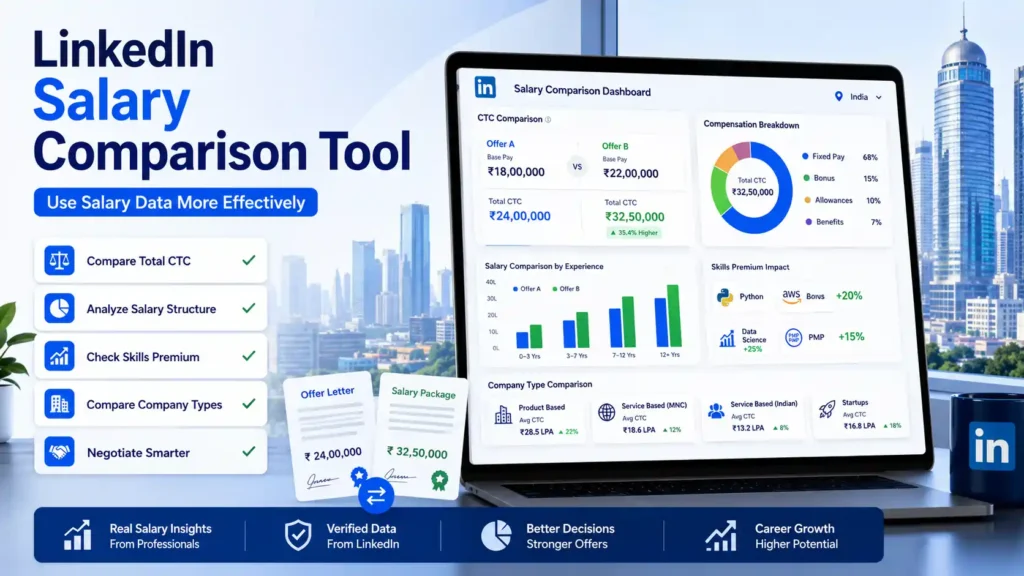
The LinkedIn salary comparison tool for Indian professionals is most powerful when used not just to find a number – but to build a complete understanding of your market positioning. Knowing how to use LinkedIn salary insights for negotiation in Delhi means going beyond just reading the median – it means using every layer of the data: skills premiums, experience brackets, company size filters, and comparable role salaries. Here is how to extract maximum value from it:
Use It to Understand Total Compensation Structure
Delhi salaries – especially in corporate, consulting, and tech sectors – are structured very differently from company to company. The LinkedIn LinkedIn salary tool shows base pay ranges, but a complete salary negotiation LinkedIn Delhi strategy requires understanding total compensation, which includes:
- Fixed base salary – the guaranteed monthly component, typically 40 to 60 percent of CTC in Delhi’s corporate sector
- Variable pay / performance bonus – often 10 to 30 percent of CTC, paid quarterly or annually. Delhi’s financial and consulting sectors have particularly high variable components
- Allowances – HRA, transport, meal, and phone allowances that form a significant portion of CTC in Indian salary structures
- Benefits – health insurance, PF contribution, gratuity, stock options (increasingly common in Delhi startups and MNCs)
- Signing bonus – increasingly common in Delhi’s competitive hiring market for roles in tech, consulting, and BFSI where notice periods create a gap
When using LinkedIn salary insights for negotiation, always clarify whether the number you are citing is base salary or CTC. In Delhi’s job market, the difference between these two figures can be 30 to 40 percent – and miscommunication on this point during negotiation is one of the most common and costly mistakes professionals make.
Use It to Research Roles You Did Not Apply For
One underused negotiation tips strategy is researching salary data for roles adjacent to the one you are negotiating for. If you are negotiating a Senior Analyst offer, check what a Manager earns at the same company and in the same Delhi market. If the gap between the two levels is small – use that data to argue you should be placed at the higher level given your experience. This is a salary negotiation LinkedIn Delhi tactic that very few candidates use but experienced negotiators swear by.
Use Skills Premium Data as Negotiation Evidence
The LinkedIn salary insights page shows which specific skills correlate with higher pay for your role in Delhi. Here is how to use this in negotiation:
- Screenshot or note the skills premium percentages LinkedIn shows for your role in Delhi
- Identify which of those premium skills you have
- In your negotiation conversation, specifically reference these skills: ‘LinkedIn’s salary data for this role in Delhi shows that professionals with [skill] earn an average of [X]% more than the baseline. Given that I have [X years] of experience with [skill], I believe the upper end of the range is appropriate for my profile’
This is one of the most credible and data-backed salary negotiation tips using LinkedIn for Delhi job offers available – because you are not just claiming to be worth more, you are citing a specific, verifiable platform that quantifies exactly why.
What Is the Average Salary in Delhi for Common Roles – LinkedIn Data Benchmarks 2026
One of the most searched questions by Delhi professionals is what is the average salary in Delhi for my role. While individual circumstances vary significantly, here are realistic salary benchmarks for common Delhi NCR roles based on LinkedIn salary data trends and market compensation research for 2026:
| Role | Experience Level | Delhi NCR Salary Range (Annual CTC) | Gurugram Premium | Notes |
| Software Engineer | 2 to 4 years | INR 8 to 18 LPA | +10 to 15% | Higher for product companies vs service companies |
| Senior Software Engineer | 5 to 8 years | INR 18 to 35 LPA | +10 to 20% | Full-stack, cloud, and AI skills command top range |
| Product Manager | 3 to 6 years | INR 15 to 30 LPA | +15 to 20% | B2B SaaS PM roles at higher end of range |
| Business Analyst | 2 to 5 years | INR 7 to 16 LPA | 0.1 | Consulting BAs typically earn more than in-house |
| Data Analyst / Data Scientist | 2 to 5 years | INR 8 to 22 LPA | +10 to 15% | ML and AI skills significantly boost range |
| Marketing Manager | 4 to 7 years | INR 10 to 20 LPA | +5 to 10% | Digital marketing skills at premium in Delhi |
| HR Manager | 5 to 8 years | INR 8 to 18 LPA | +5 to 10% | HRBP and HR Analytics command top range |
| Finance Manager / CA | 4 to 8 years | INR 12 to 25 LPA | +10 to 15% | BFSI-specific roles at top of range |
| Sales Manager | 4 to 7 years | INR 8 to 20 LPA + variable | Varies | Variable component often equals or exceeds fixed |
| UI/UX Designer | 3 to 6 years | INR 8 to 18 LPA | +5 to 15% | Product design experience commands premium |
Important note: These ranges represent approximate Delhi salary data benchmarks based on LinkedIn salary insights and publicly available market data as of 2026. Actual salaries vary significantly based on company type (MNC vs startup vs Indian corporate), specific skills, educational background, and individual negotiation. Always verify against current LinkedIn salary tool data for your specific role and target company before entering any negotiation.
How to Negotiate Salary Using LinkedIn – The Complete Delhi Strategy
Putting everything together into one complete salary negotiation LinkedIn Delhi strategy requires combining data research with timing, communication, and psychological confidence. Here is the full framework:
The PREP Framework for Delhi Salary Negotiation
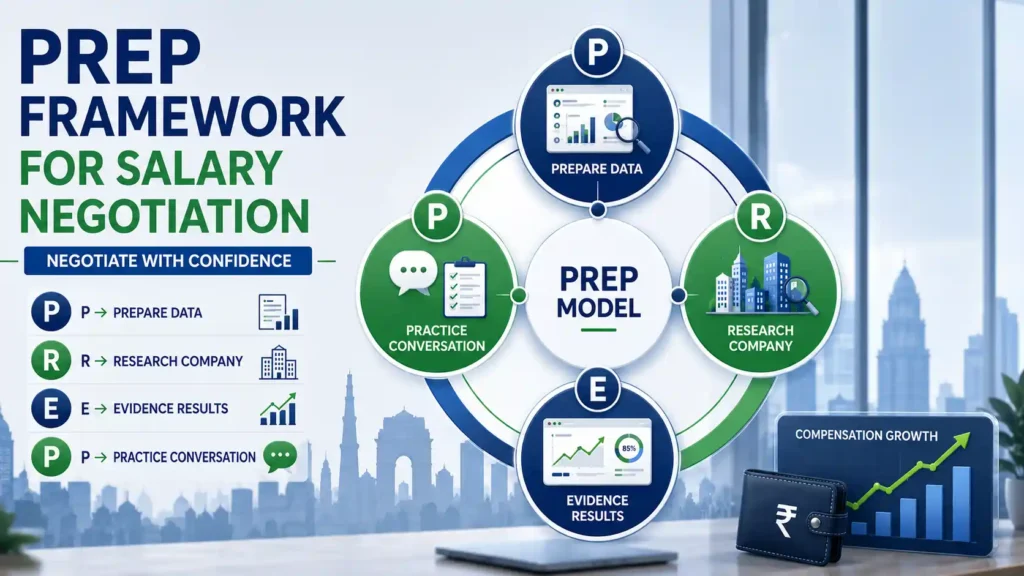
- P – Prepare your data – Use LinkedIn salary insights, AmbitionBox, and Glassdoor to build your target range. Know your walk-away number, target number, and opening ask before the conversation begins
- R – Research the company specifically – Understand the company’s size, funding stage, sector, and typical pay structure for Delhi. A Series B startup and a Gurugram MNC have very different salary structures and negotiation dynamics
- E – Evidence your worth – Prepare 2 to 3 specific achievements with numbers: ‘I increased revenue by X’, ‘I reduced costs by Y’, ‘I managed a team of Z’. Data-backed evidence + LinkedIn salary data for Delhi professionals 2026 = an almost unassailable negotiation position
- P – Practice the conversation – Say your target number out loud before the actual conversation. Most Delhi professionals have never said their target salary out loud and feel uncomfortable doing it in the moment. Practice removes that discomfort
The Negotiation Conversation Structure – Step by Step
| Stage | What to Say | Purpose |
| Acknowledge the offer | Thank you – I am very excited about this opportunity’ | Positive opening, no defensive energy |
| Reference your research | Based on my research of market rates for this role in Delhi, including LinkedIn salary data…’ | Cite evidence, not emotion |
| State your target | I was hoping we could discuss a base of [X]’ | Clear, specific, confident ask |
| Pause | Say nothing – wait for their response | Let them respond; silence is not your problem to fill |
| Handle pushback | I understand – could we explore [signing bonus / early review / variable component]?’ | Show flexibility while holding position |
| Close positively | I want to make this work – if we can get to [X], I am ready to sign’ | Give them a clear path to yes |
Also Read – LinkedIn Premium Pricing Guide 2026: Cost, Plans, India Price & Is It Worth It?
Common Salary Negotiation Mistakes Delhi Professionals Make – And How to Avoid Them
Even with strong LinkedIn salary data for Delhi professionals 2026 in hand, certain negotiation mistakes consistently cost Delhi professionals money. Here are the most common ones:
- Mistake 1: Accepting the first offer immediately – Delhi hiring managers almost always have budget flexibility above the initial offer. Accepting immediately signals that you did not do market research and leaves money on the table
- Mistake 2: Anchoring to current salary – Your current salary at your previous company has nothing to do with your market value in Delhi’s 2026 job market. Always anchor to market data from your LinkedIn salary tool research, not where you started
- Mistake 3: Negotiating only on base salary – Total compensation Delhi is a package. If base is fixed, negotiate on signing bonus, variable percentage, equity, joining date, leave policy, or review timeline
- Mistake 4: Making it personal – ‘I need more because my EMI is high’ is a personal reason, not a market reason. Delhi hiring managers respond to data, not personal circumstances. Keep the conversation anchored to LinkedIn salary insights and market benchmarks
- Mistake 5: Giving a range when asked for a number – When asked ‘what are you looking for?’ – giving a range always results in the employer anchoring to the lower end. Give a specific number, not a range
- Mistake 6: Negotiating over WhatsApp or email for complex offers – Delhi’s professional culture still values phone or in-person conversations for substantive negotiations. A WhatsApp message for a salary counter-offer can come across as casual or uncommitted. Prefer a call
Ready to Negotiate Better and Get the Salary You Actually Deserve in Delhi?
You have done the hard thinking.
You now have the complete salary negotiation LinkedIn Delhi playbook – from researching LinkedIn salary insights and cross-referencing Delhi salary data to walking into a negotiation room with a number backed by real market evidence. The only question left is: do you have the right premium tools to back up your job search and negotiation strategy?
At PremiumToolsHub, we have helped 650+ professionals, freelancers, and agencies across 15+ countries access the exact same premium tools they were already using – just at prices that finally make sense. Here is what you get when you work with us:
- Proper billing invoice with every purchase – every transaction is clean, documented, and professional.
- Real human support on WhatsApp, 9 AM to 12 AM IST – no bots, no queues. A real person answers – usually within a few hours.
- 100% legitimate access through proper licensing – official family plans, team workspaces, and authorized reseller programs. No cracked software. No risk.
- Way more than just LinkedIn Premium – AI tools, design tools, productivity suites and more – all in one place, all backed by the same support.
Visit premiumtoolshub.in or send a message on WhatsApp to see exactly how much you could be saving – starting from your very next billing cycle.
FAQ – People Also Ask
1. How to check salary on LinkedIn for Delhi jobs?
To check salary on LinkedIn for Delhi jobs, go to linkedin.com/salary on desktop or use the salary filter in LinkedIn’s Jobs search. Enter your job title and set the location to Delhi, Gurugram, or Noida depending on where your target role is based. LinkedIn will show you a salary distribution – base pay at the 25th, 50th, and 75th percentile – along with breakdowns by experience level, education, and company size. The LinkedIn salary tool also shows which skills correlate with higher pay for your specific role in Delhi, which is directly useful in salary negotiation LinkedIn Delhi conversations.
2. Is LinkedIn salary data accurate for India?
LinkedIn salary data is reasonably accurate for common roles in India’s major corporate sectors – especially IT, finance, consulting, and marketing in cities like Delhi NCR. The data is sourced from millions of self-reported salary entries from Indian professionals on LinkedIn. However, it has limitations for very niche roles, early-stage startups, and senior leadership positions where data samples are smaller. For the most reliable Delhi salary data, use LinkedIn salary insights as one of three sources – alongside AmbitionBox and Glassdoor – to cross-validate your target range before entering any negotiation.
3. How to negotiate salary using LinkedIn?
To negotiate salary using LinkedIn, start by researching your role on LinkedIn’s salary tool for your specific Delhi location and experience level. Note the 25th, 50th, and 75th percentile ranges. Supplement this with data from AmbitionBox and Glassdoor. Build a target number at the 65th to 75th percentile of your researched range. In the negotiation conversation, cite LinkedIn salary insights and market data – not personal needs – as your evidence. Reference any premium skills LinkedIn identifies as commanding higher pay for your role. And always negotiate on the full package – base, variable, signing bonus, and benefits – not just base salary. These salary negotiation tips using LinkedIn for Delhi job offers work best when combined with specific achievement-backed evidence of your professional value.
4. What is the average salary in Delhi for my role?
Average salaries in Delhi NCR vary significantly by role, sector, experience, and company type. For common corporate roles in 2026: software engineers with 2 to 4 years of experience typically earn INR 8 to 18 LPA, product managers with 3 to 6 years earn INR 15 to 30 LPA, business analysts earn INR 7 to 16 LPA, and finance managers with CA qualification earn INR 12 to 25 LPA. Roles based in Gurugram typically earn 10 to 20 percent more than equivalent roles in central Delhi. For the most accurate Delhi salary data for your specific role, use the LinkedIn salary tool with your exact job title and preferred NCR location – it provides the most current and role-specific compensation ranges available.
Conclusion: Data Is Your Best Negotiation Partner in Delhi’s Job Market
Let us bring this together. The professionals who negotiate the best salaries in Delhi are not necessarily the most experienced, the most qualified, or the most confident by nature. They are the most prepared. And in 2026, preparation means data – specifically, LinkedIn salary insights combined with other Delhi-specific salary sources, assembled into a clear target range that you can defend with specific evidence.
You now know how to use the LinkedIn salary tool to research your role in Delhi across multiple locations and experience levels. You know how to research salary on LinkedIn before accepting Delhi offer – with a three-phase research process that builds a number you can defend confidently. You understand where LinkedIn salary data for Delhi professionals 2026 is reliable and where it has limitations – and how to cross-reference it with AmbitionBox and Glassdoor for maximum accuracy.
You have the complete conversation guide – what to say when the offer arrives, how to handle pushback, how to redirect from current salary to market data, and how to use the LinkedIn salary comparison tool for Indian professionals to build skills-premium arguments that are specific and verifiable.
And you know the most common mistakes that cost Delhi professionals real money in negotiations – and exactly how to avoid each one.