Two years ago, building a SaaS MVP without a technical co-founder meant one of three painful options: spend months learning to code yourself, pay a freelance developer money you probably do not have yet, or use a no-code tool so limited that you could not build anything resembling a real product. In 2026, none of those are your only options anymore.
Lovable AI has become one of the fastest-growing tools in what the industry now calls ‘vibe coding’ – describing what you want in plain English and watching a real, functional application get built in front of you. The category is growing 38 percent year over year, and for good reason: non-technical founders are now able to build saas mvp with lovable ai in days instead of months.
This guide is a complete, honest walkthrough on how to build mvp without coding using one of the most capable tools available today. You will learn exactly how to go from an idea to a working MVP, how lovable ai no code app builder actually works under the hood, how to connect a real database using Supabase, what Lovable AI credits actually mean for your budget, and – most importantly – whether can lovable ai build a real working saas product that you can actually launch and charge customers for. No hype. Just the practical truth.
Let us start with what Lovable AI actually is.
What Is Lovable AI and How Does It Let You Build Without Code?
Before you can build saas mvp with lovable ai successfully, it helps to understand exactly what the tool is. Lovable AI is a lovable ai full stack app builder that generates real, working web applications from natural language descriptions. Unlike older drag-and-drop no-code tools, Lovable AI writes actual code behind the scenes – React for the frontend, with database and backend logic connected through integrations like Supabase. The difference matters enormously: you are not building inside a limited visual builder with predefined blocks. You are generating a real, exportable, modifiable codebase through conversation.
Here is how the core workflow works:
- You describe what you want to build in a chat interface – ‘Build me a task management app where users can create projects, add tasks, and mark them complete’
- Lovable AI generates a working application in real time, with a live preview you can interact with immediately
- You continue the conversation to refine – ‘Add a dashboard showing task completion percentage’ or ‘Change the colour scheme to dark mode’
- Each change updates the live application instantly, and you can see exactly what was built and modified
- When you are ready, you connect a real database (typically Supabase), add authentication, and the app becomes a genuinely functional product
| Traditional No-Code Tools | Lovable AI (Vibe Coding) |
| Drag-and-drop interface with predefined blocks | Natural language conversation generates real code |
| Limited to platform-specific templates and logic | Can build genuinely custom application logic |
| Difficult to extend beyond the platform’s design | Generates real React code you technically own and can export |
| Often produces apps that ‘feel’ like no-code products | Produces apps indistinguishable from developer-built products |
| Steep learning curve for complex logic | Conversational refinement – describe changes in plain English |
Did You Know? The term ‘vibe coding’ was popularized in early 2025 to describe building software through natural language prompts rather than traditional syntax-based coding. By 2026, the category – which includes tools like Lovable AI, Bolt, and Replit’s AI agent – has grown 38% year over year, driven primarily by non-technical founders who previously had no viable path to building their own MVP without a technical co-founder or significant capital.
Also Read – How to Use Claude AI for Content Writing, Research and Productivity in India (2026)
How to Build a SaaS MVP Using Lovable AI Step by Step 2026
Now that you understand what the tool is, here is the complete how to build a saas mvp using lovable ai step by step 2026 process to build saas mvp with lovable ai – from a blank idea to a working, deployable product:
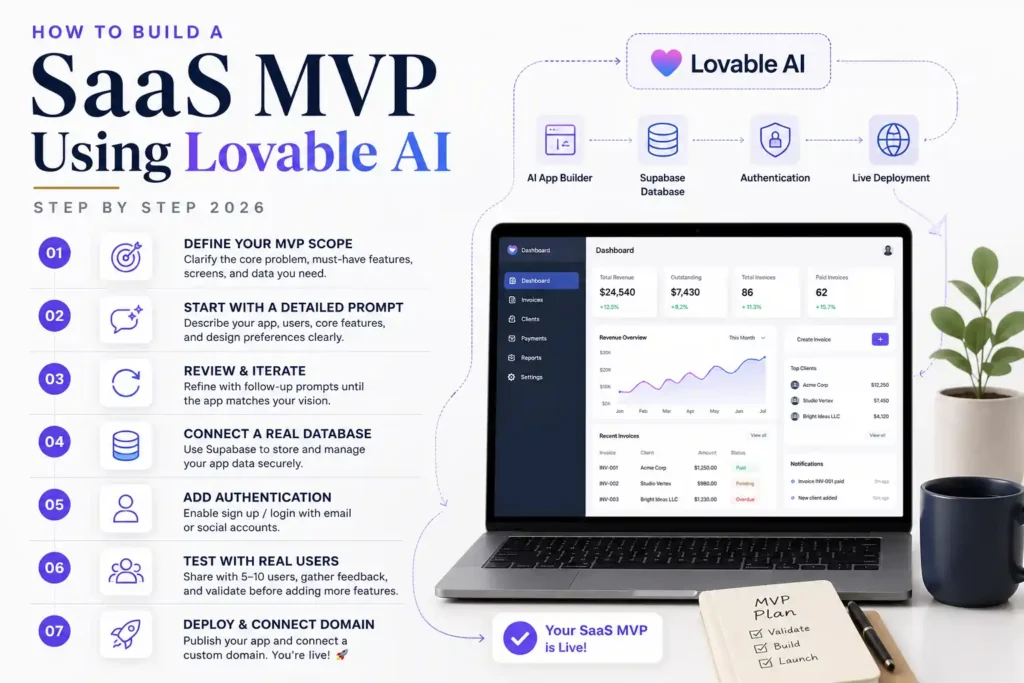
Step 1: Define Your MVP Scope Before You Open Lovable AI
The single biggest mistake non-technical founders make is opening Lovable AI without a clear plan. Before writing your first prompt:
- Write down the ONE core problem your SaaS solves – not five features, one core job
- List the 3 to 5 absolute must-have features for a minimum viable version – not your full vision
- Sketch (even on paper) the basic screens: landing page, sign-up, main app screen, settings
- Identify what data your app needs to store – this determines your database structure later
Step 2: Start With a Detailed First Prompt
The quality of your first prompt to Lovable AI significantly affects how close the first version gets to your vision. A strong first prompt for lovable ai no code app builder includes:
- The type of application – ‘Build a SaaS dashboard for…’ or ‘Build a customer-facing web app for…’
- Who the users are and what they do in the app
- The core 3 to 5 features, described clearly
- Any specific design preference – ‘minimal and modern’, ‘colourful and playful’, ‘professional and corporate’
Example strong prompt: ‘Build a SaaS app for freelancers to track client invoices. Users should be able to sign up, add clients, create invoices with line items, mark invoices as paid or unpaid, and see a dashboard with total outstanding amount. Use a clean, modern design with a blue and white colour scheme.’
Step 3: Review the Generated App and Iterate
Lovable AI will generate a working version within minutes. Do not expect perfection on the first try – this is a conversation, not a one-shot generation. Review what was built and refine through follow-up prompts:
- ‘The invoice form needs a date field and a due date field’
- ‘Add a search bar to filter clients by name’
- ‘The dashboard numbers should update automatically when an invoice status changes’
- Each iteration narrows the gap between what exists and your actual vision
Step 4: Connect a Real Database
This is the step that turns a prototype into a real product – covered in full detail in the next section on connecting Supabase.
Step 5: Add Authentication and User Accounts
For any real SaaS product, you need users to sign up and log in securely. Lovable AI integrates with Supabase Auth, allowing you to add email/password login, social logins (Google, GitHub), and protected routes through simple prompts like ‘Add user authentication so users must sign in to access the dashboard.’
Step 6: Test With Real Users Before Adding More Features
Once your core MVP is functional, resist the urge to keep adding features. Share it with 5 to 10 potential users, watch how they use it, and let their actual behaviour – not your assumptions – guide your next round of prompts to Lovable AI.
Step 7: Deploy and Connect a Custom Domain
Lovable AI provides built-in deployment, letting you publish your app with one click and connect a custom domain. This is the final step in the how to build a saas mvp using lovable ai step by step 2026 process – your MVP is now live and accessible to real users on the internet.
Also Read – Claude AI vs ChatGPT Plus vs Gemini Advanced: Which AI Subscription Should You Buy in India in 2026?
How to Connect Supabase Database to Lovable AI App – Complete Guide
Understanding how to connect supabase database to lovable ai app is the single most important technical step in turning a Lovable AI prototype into a genuinely functional SaaS product. Supabase is an open-source backend platform that provides a real PostgreSQL database, authentication, and file storage – and Lovable AI has built-in native integration with it.
Why Supabase Specifically
- Native Lovable AI integration – Lovable AI is built to work directly with Supabase, meaning the connection process is largely automated rather than requiring manual API configuration
- Real PostgreSQL database – this is not a toy database. Supabase runs on production-grade PostgreSQL, the same database technology used by serious, scaled software companies
- Built-in authentication – Supabase Auth handles user sign-up, login, password resets, and social logins without you needing to build any of this logic yourself
- Generous free tier – Supabase’s free tier supports real early-stage usage, meaning your MVP database costs nothing until you have actual traction
The Connection Process
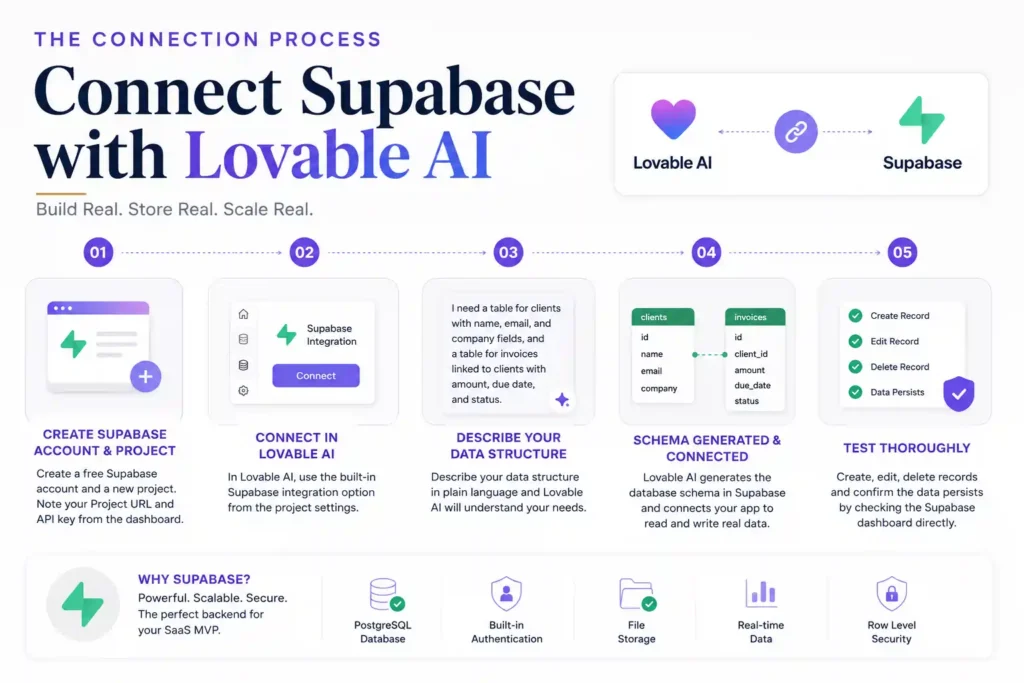
- Step 1 – Create a free Supabase account and a new project. Note your project URL and API key from the Supabase dashboard
- Step 2 – In Lovable AI, use the built-in Supabase integration option, which is typically a direct connection button within the project settings
- Step 3 – Once connected, describe your data structure to Lovable AI in plain language: ‘I need a table for clients with name, email, and company fields, and a table for invoices linked to clients with amount, due date, and status’
- Step 4 – Lovable AI generates the actual database schema in Supabase and connects your app’s forms and displays to read and write real data
- Step 5 – Test thoroughly: create a record, edit it, delete it, and confirm the data persists correctly by checking the Supabase dashboard directly
| What You Get After Connecting Supabase | Why It Matters for Your MVP |
| Real, persistent data storage | User data is not lost when the browser closes – this is a real product now |
| Multi-user support | Different users see their own data, not a shared demo state |
| Authentication and secure access | Users have accounts; data is protected and private to each account |
| Scalability for early growth | Supabase can handle real early customer usage without rebuilding |
| Direct database access for debugging | You can view and edit data directly in Supabase’s dashboard if needed |
Did You Know? Supabase has become the default database choice for the vibe coding ecosystem precisely because of its open architecture and generous free tier. Founders building their first SaaS MVP with Lovable AI typically stay within Supabase’s free tier limits for their first several hundred users – meaning the database itself adds zero cost during the critical early validation phase of building saas mvp with lovable ai products.
Lovable AI Credits Explained – How Many You Need for an MVP
Budgeting credits correctly is essential whether you build saas mvp with lovable ai for the first time or the fifth. One of the most common points of confusion for new users is lovable ai credits explained how many needed for mvp – and getting this wrong leads to either overpaying or running out of credits mid-build. Here is the honest breakdown:
How Lovable AI Credits Work
Lovable AI operates on a credit system where each prompt or generation consumes a certain number of credits, depending on the complexity of the request. A simple style change (‘make the buttons rounded’) consumes fewer credits than a complex feature build (‘add a complete payment system with Stripe integration’).
Realistic Credit Usage for a Typical MVP
| MVP Build Stage | Approximate Prompts Needed | Credit Intensity | Notes |
| Initial app generation | 1 to 3 prompts | Medium-High | First prompt typically uses more credits due to full app generation |
| Core feature refinement | 15 to 30 prompts | Medium | Iterating on forms, layouts, and basic logic |
| Database connection (Supabase) | 5 to 10 prompts | Medium | Schema creation and connecting forms to real data |
| Authentication setup | 3 to 5 prompts | Medium | Sign up, login, protected routes |
| Design and styling polish | 10 to 20 prompts | Low-Medium | Colour, spacing, responsive design fixes |
| Bug fixes and edge cases | 10 to 25 prompts | Low-Medium | Ongoing as you test and discover issues |
| Total typical MVP | 45 to 90 prompts | – | Varies significantly based on MVP complexity |
For most first-time founders building a focused MVP with 3 to 5 core features, a mid-tier Lovable AI plan covers the build comfortably, with room for iteration after initial user feedback. The key to managing credits efficiently is Step 1 from the earlier section – having a clear scope before you start prevents the credit waste that comes from exploratory, undirected prompting.
How to Use Credits Efficiently
- Batch your requests – instead of five small prompts (‘make this button blue’, ‘now make it bigger’, ‘now add an icon’), combine related changes into one detailed prompt
- Plan before you prompt – refer back to your MVP scope document instead of exploring features you have not committed to building
- Use the chat history – Lovable AI maintains context, so you do not need to re-explain your app’s purpose in every prompt
- Save complex feature requests for when you are certain – validate the need for a feature with potential users before spending credits building it
Also Read – Best Tools for Indian MBA Students and Business School Aspirants 2026
Lovable AI vs Hiring a Developer for MVP – Complete Cost Comparison
The most practical decision-making question for non-technical founders is lovable ai vs hiring developer for mvp cost comparison. Here is the honest, complete breakdown:
| Factor | Hiring a Freelance Developer | Lovable AI |
| Typical cost for a basic MVP | $1,500 to $8,000+ (India: INR 50,000 to 4,00,000+) | Monthly subscription – a fraction of developer cost |
| Time to first working version | 2 to 6 weeks | Minutes to hours for first version |
| Iteration speed | Days to weeks per change request | Minutes per change via prompt |
| Technical debt risk | Depends entirely on developer skill and communication | Generally clean, modern code structure (React + Supabase) |
| Ability to make changes yourself | None – fully dependent on the developer | Full ability to iterate via prompts, no coding needed |
| Best for | Highly complex, custom backend logic, enterprise integrations | Standard SaaS patterns: CRUD apps, dashboards, marketplaces, tools |
| Risk of miscommunication | High – translating your vision to a developer often loses nuance | Lower – you directly describe and immediately see results |
| Long-term scalability | Depends on developer’s architecture decisions | Good for MVP and early growth; may need developer help at significant scale |
The honest verdict on lovable ai vs hiring developer for mvp cost comparison: for the vast majority of standard SaaS MVPs – task managers, CRMs, booking systems, content platforms, marketplaces – Lovable AI delivers a working product faster and at a fraction of the cost of hiring a developer. Where hiring a developer still makes sense is for highly specialised technical requirements: complex real-time systems, heavy data processing pipelines, or deep integrations with legacy enterprise systems that go beyond what conversational app building handles well.
Many successful founders are now using a hybrid approach: building and validating their MVP with Lovable AI first, and only bringing in a developer once they have paying customers and a clear case for more complex, custom engineering.
Lovable AI for Non-Technical Founders – What You Actually Need to Know
If you are a lovable ai for non technical founders reader with zero coding background trying to build saas mvp with lovable ai for the first time, here is what genuinely matters for your success – beyond just learning the tool:
You Still Need to Think Like a Product Person
Lovable AI removes the coding barrier, not the product thinking barrier. Understanding your users, defining clear feature priorities, and making good design decisions are still entirely your responsibility. The tool builds what you describe – it does not replace product judgment.
Learn Basic Technical Vocabulary
You do not need to code, but understanding terms like ‘database’, ‘authentication’, ‘API’, and ‘deployment’ at a conceptual level will dramatically improve how effectively you communicate with Lovable AI and how confidently you make decisions about your product’s architecture.
Embrace the Iterative Process
Your first generated app will not be perfect. Non-technical founders who succeed with lovable ai no code app builder treat the process as a conversation and a craft, refining through dozens of prompts rather than expecting one perfect generation.
Join the Community
Lovable AI has an active community of non-technical builders sharing prompts, troubleshooting tips, and template approaches. For lovable ai for non technical founders specifically, learning from others who have solved similar problems – authentication flows, payment integrations, complex form logic – saves significant time and credits.
Know When to Get Help
Even with Lovable AI, certain situations benefit from outside expertise: complex payment compliance requirements, specific security audits before handling sensitive data, or particularly intricate business logic. Knowing when to consult a developer for a specific question – without abandoning the no-code approach entirely – is a sign of a maturing technical founder.
Can Lovable AI Build a Real Working SaaS Product – The Honest Answer
This is the question every serious founder asks before committing time to the platform: can lovable ai build a real working saas product that customers can actually use and pay for? The honest answer is yes – with specific conditions and caveats.
What Lovable AI Handles Well
- Standard SaaS application patterns – dashboards, CRUD operations, user accounts, data tables, forms
- Subscription and payment integration through Stripe, enabling genuine revenue collection
- Multi-user applications with proper authentication and data isolation per user
- Responsive design that works across desktop and mobile devices
- Real, production-grade database operations through Supabase
Where Lovable AI Has Limitations
- Extremely complex real-time features (live collaborative editing like Google Docs) may require more sophisticated custom engineering
- Highly specialised compliance requirements (certain healthcare or financial regulations) may need developer oversight and audit
- Very high-scale performance optimisation, once you have significant user volume, often benefits from dedicated engineering attention
- Deep integrations with complex legacy enterprise systems may exceed what conversational building handles smoothly
Real Examples of What Founders Have Built
Founders using Lovable AI in 2026 have launched and monetised: project management tools for niche industries, subscription-based content platforms, internal business tools sold to other small businesses, booking and scheduling SaaS products, and data dashboard tools for specific verticals. These are not toy demos – they are products with real paying customers, built and iterated entirely through vibe coding tools for saas platforms like Lovable AI.
The honest conclusion: can lovable ai build a real working saas product? Yes, for the large majority of standard SaaS use cases. The tool has moved well beyond prototyping into genuine production capability – but founders should understand its boundaries before betting their entire roadmap on features that push into genuinely complex technical territory.
Did You Know? A growing number of solo founders who built their MVP entirely with Lovable AI have gone on to raise pre-seed funding by demonstrating a working product with real users – something that was previously only possible with either a technical co-founder or significant upfront capital for development. Investors increasingly care less about how the MVP was built and more about whether it demonstrates genuine user demand and traction.
Also Read – How Agencies Reduce SaaS Costs by 50%
Vibe Coding Tools for SaaS – How Lovable AI Compares to Alternatives
Lovable AI is the most prominent name in vibe coding tools for saas, but it is not the only option. Here is an honest comparison to help you understand where it fits:
| Tool | Best For | Database Integration | Learning Curve |
| Lovable AI | Full-stack SaaS apps with real database needs | Native Supabase integration | Low – conversational building |
| Bolt | Quick prototypes and frontend-heavy apps | Possible but less seamless than Lovable AI | Low – similar conversational approach |
| Replit AI Agent | Founders who may eventually want code-level control | Flexible but requires more technical understanding | Medium – closer to traditional coding environment |
| Traditional no-code (Bubble, etc.) | Visual builders without writing prompts | Built-in but more rigid structure | Medium – requires learning the visual builder logic |
For most non-technical founders specifically focused on building a genuine SaaS product with user accounts and a real database – build saas mvp with lovable ai remains the most balanced choice in 2026, combining ease of use with the technical depth (real React code, native Supabase integration) needed for a product that can actually scale beyond an MVP.
Common Mistakes Non-Technical Founders Make With Lovable AI – And How to Avoid Them
Even with the best tool available, founders make avoidable mistakes when they build saas mvp with lovable ai for the first time. Here are the most common ones and how to sidestep them:
- Mistake 1: Building too many features before validating the core idea – spend your first credits on the absolute minimum viable version, not your full product vision
- Mistake 2: Vague prompts – ‘make it better’ or ‘fix the design’ gives Lovable AI too little to work with. Be specific: ‘increase the spacing between form fields and make the submit button more prominent’
- Mistake 3: Skipping the database connection too long – testing an app with fake or temporary data for too long delays discovering real data structure problems
- Mistake 4: Not testing with real users early – founders who build in isolation for weeks before showing anyone often discover fundamental misunderstandings about what users actually need
- Mistake 5: Ignoring credit-efficient prompting – combining related changes into single, detailed prompts instead of many small ones preserves your credit budget for the iterations that matter most
Also Read – What Is ChatGPT? The AI Tool That’s Changing How We Work
Ready to Build Your SaaS MVP With Lovable AI – Without the Full-Price Tag?
You have done the hard thinking.
You now know exactly how to build saas mvp with lovable ai – from your first prompt to a working product with a real database, authentication, and payments. You understand lovable ai credits explained how many needed for mvp, how to connect Supabase, and when Lovable AI is the right tool versus hiring a developer. The only question left is: how do you access Lovable AI without paying full international pricing as an Indian founder?
At PremiumToolsHub, we give Indian founders, freelancers, and agencies access to Lovable AI and the complete vibe coding tools for saas stack at prices that actually make sense for bootstrapped builders. Here is what you get:
- Lovable AI access – build your MVP without paying full retail subscription pricing
- ChatGPT Plus and Gemini Advanced – for prompt refinement, copywriting, and feature planning alongside your build
- Notion – to plan your MVP roadmap, track features, and document your product as you build
- Canva Pro and Gamma – for your landing page visuals, pitch deck, and launch assets
- Proper billing invoice with every purchase – clean, documented, professional
- Real human support on WhatsApp, 9 AM to 12 AM IST – a real person answers, usually within a few hours
- 100% legitimate access through proper licensing – official channels only, zero risk to your project
Visit premiumtoolshub.in or WhatsApp us to start building your MVP today – without burning your runway on tools.
FAQ – Common Questions
Can Lovable AI really build a working SaaS product, or just a demo?
Yes – can lovable ai build a real working saas product is one of the most common questions, and the honest answer is yes for the majority of standard SaaS patterns. With native Supabase integration for real databases, built-in authentication, and Stripe payment integration, Lovable AI produces genuinely functional products that founders have launched, monetised, and scaled. The limitations appear at the edges – highly complex real-time features or specialised compliance requirements – but for dashboards, CRMs, booking tools, and content platforms, it is a real product, not a demo.
How many Lovable AI credits do I actually need to build my first MVP?
Based on typical builds, lovable ai credits explained how many needed for mvp comes down to roughly 45 to 90 prompts for a focused MVP with 3 to 5 core features – covering initial generation, database connection, authentication, styling, and bug fixes. Complex apps with many features will need more. The most credit-efficient approach is having a clear feature scope before you start and batching related changes into single, detailed prompts rather than many small exploratory ones.
Is it cheaper to use Lovable AI or hire a developer for my MVP?
In almost every case for a standard SaaS MVP, Lovable AI is significantly cheaper than hiring a developer. A lovable ai vs hiring developer for mvp cost comparison shows that a freelance developer MVP build typically costs $1,500 to $8,000 or more, while Lovable AI operates on an affordable monthly subscription. The exception is highly specialised technical requirements – deep enterprise integrations or extremely complex real-time systems – where a skilled developer’s expertise becomes necessary regardless of cost.
Do I need to know how to connect a database to use Lovable AI properly?
You do not need prior technical knowledge, but understanding how to connect supabase database to lovable ai app conceptually helps you build a genuinely functional product rather than a temporary prototype. The actual connection process is largely guided within Lovable AI’s interface – you describe your data structure in plain language, and the platform handles the technical schema creation in Supabase. Learning this single integration is the most important technical step for any lovable ai for non technical founders wanting to launch a real product, not just a demo.
Conclusion: Your SaaS MVP Is Closer Than You Think
The barrier that used to stop most non-technical founders – the need to code or the cost of hiring someone who can – has genuinely changed in 2026. Going from a blank idea to a working, deployed product no longer requires either. You have the complete step-by-step process now: how to structure your first prompt, how to connect a real database through Supabase for actual data persistence, and roughly how many credits a typical build needs so you are not guessing halfway through.
You also have an honest cost comparison between this approach and hiring a developer – one that shows exactly where each makes sense rather than pretending one is always better. Even with zero coding background, the path is genuinely workable, and the evidence is clear: yes, this can produce a real, working SaaS product for the large majority of standard patterns that most first-time founders are building – not just a demo.
What it will not do is solve product thinking, market validation, or the hard work of finding customers who actually want what you are building. No-code, AI-driven app building removes the single biggest obstacle that used to stop good ideas before they even got a chance: the technical barrier to building something real.
Your idea does not need a technical co-founder anymore. It needs a clear scope, a good first prompt, and the willingness to iterate. Start today.